Demo Application
For my Demo program I wanted to make something that would mimic how it would be used in real world application. Therefore I created something like backbone of a light engine. Nothing too complex, but very customisable.
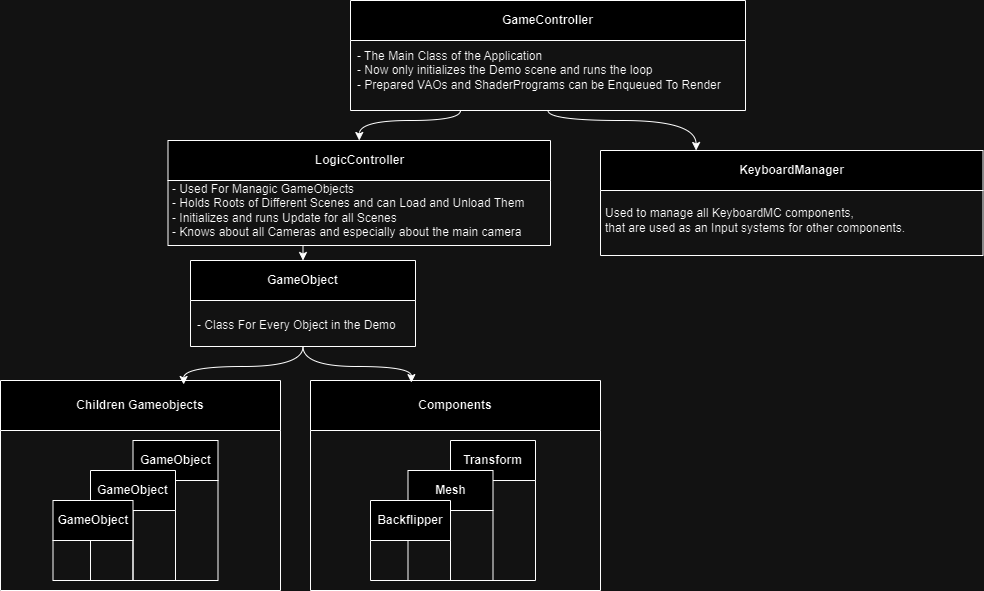
GameController
As you can see the demos application main class is GameController. This Class is responsible for operating the Game Loop, Setting important variables such as Time, and drawing using the CPU Renderer. It holds 2 important objects, LogicController and KeyboardManager.
LogicController
This object serves to shift the burden of controlling logical parts of the application. For instance scene management, initialization of objects, run of the objects Update methods. It holds "Scenes" (Any GameObject on top of hierarchy) in dictionary where key is the name of the scene. Therefore, you can have multiple loaded scenes at once.
GameObjects
Basicaly the same thing as you would expect. These objects are the objects to which you can assign ObjectComponents. Each gameobject has to have one ObjectComponent Transform, that has object position, rotation and scale. Each GameObject can be child of another GameObject, but only one GameObject. This makes the scene hierarchy where the root is just another GameObject.
ObjectComponents
These are customizable, but I created some component just to showcase the application. They are nothing special, but there is one important I should talk about. KeyboardMC is for handling input for other components. They are registered to KeyboardManager and can process Push, Release and Hold actions. Very easy to configure, all you need is to say "Hey, I want this function to be called when holding this key". And they do just that.
KeyboardManager
It's role is simple, retraffic inputs to other registered KeyboardMC components. KeyboardMC will register at their Start method and then Unregister when they are destroyed.